T-cell immunotherapy has transformed the treatment landscape for hematological malignancies and is rapidly expanding into solid tumors, autoimmune diseases, and infectious diseases. Technologies such as CAR-T cells, TCR-T cells, and tumor-infiltrating lymphocytes (TILs) have demonstrated that a patient’s own immune cells can be engineered into powerful therapeutics.
Behind every successful T-cell therapy, however, lies a sophisticated manufacturing process that depends on high-quality recombinant proteins, antibodies, and cell culture reagents. These biologics are the foundation for producing potent, consistent, and clinically effective cell therapies.
The manufacturing process begins by collecting T cells from a patient’s blood through leukapheresis. Freshly isolated T cells are largely resting cells and must first be activated before they can be genetically engineered.
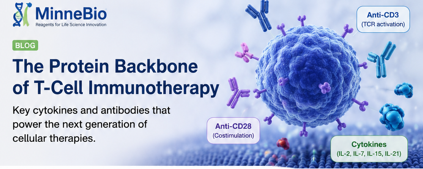
Activation is achieved by stimulating two essential signaling pathways:
These antibodies are commonly immobilized on magnetic beads or synthetic nanomatrices, closely mimicking natural immune activation. Once activated, T cells rapidly proliferate and become receptive to viral transduction or genome editing.
Following activation, cytokines support cell growth and guide T-cell differentiation.
IL-2 has been the gold standard cytokine for T-cell expansion for decades. It promotes rapid proliferation and is still widely used in both research and clinical manufacturing.
IL-7 supports the survival of naïve and memory T cells, helping maintain cells with superior long-term persistence.
IL-15 encourages the generation of central memory and stem cell memory T cells, which exhibit improved persistence after infusion into patients.
IL-21 helps preserve T-cell functionality while reducing exhaustion during extended culture. It is increasingly incorporated into next-generation manufacturing protocols.
Today, many manufacturers favor combinations such as IL-7 + IL-15, or IL-7 + IL-15 + IL-21, instead of relying solely on high-dose IL-2. These cytokine cocktails generate less differentiated T cells with greater persistence and improved therapeutic performance.
Once activated, T cells are genetically modified using viral vectors or genome-editing technologies to express therapeutic receptors.
Common approaches include:
The engineered cells are then expanded to hundreds of millions or even billions of cells before formulation and patient infusion.
Besides cytokines, several recombinant proteins play critical roles in T-cell production:
Each reagent contributes to manufacturing consistency, product quality, and regulatory compliance.
Unlike conventional pharmaceuticals, living cell therapies cannot be purified at the end of manufacturing to remove process variability. Every reagent introduced during cell culture can influence T-cell phenotype, expansion efficiency, potency, and ultimately clinical outcomes.
For this reason, manufacturers increasingly rely on recombinant, animal-origin-free, high-purity proteins that deliver lot-to-lot consistency and support scalable GMP manufacturing.
As T-cell immunotherapies continue to evolve, so too will the demand for reliable, high-quality biological reagents. Cytokines such as IL-2, IL-7, IL-15, and IL-21, together with activation antibodies and other recombinant proteins, form the molecular foundation of modern cell therapy manufacturing.
At MinneBio, we are committed to developing premium recombinant proteins and bioreagents that enable researchers and manufacturers to advance the next generation of life-saving cell therapies.
Better proteins. Better science. Better therapies.
SHARE