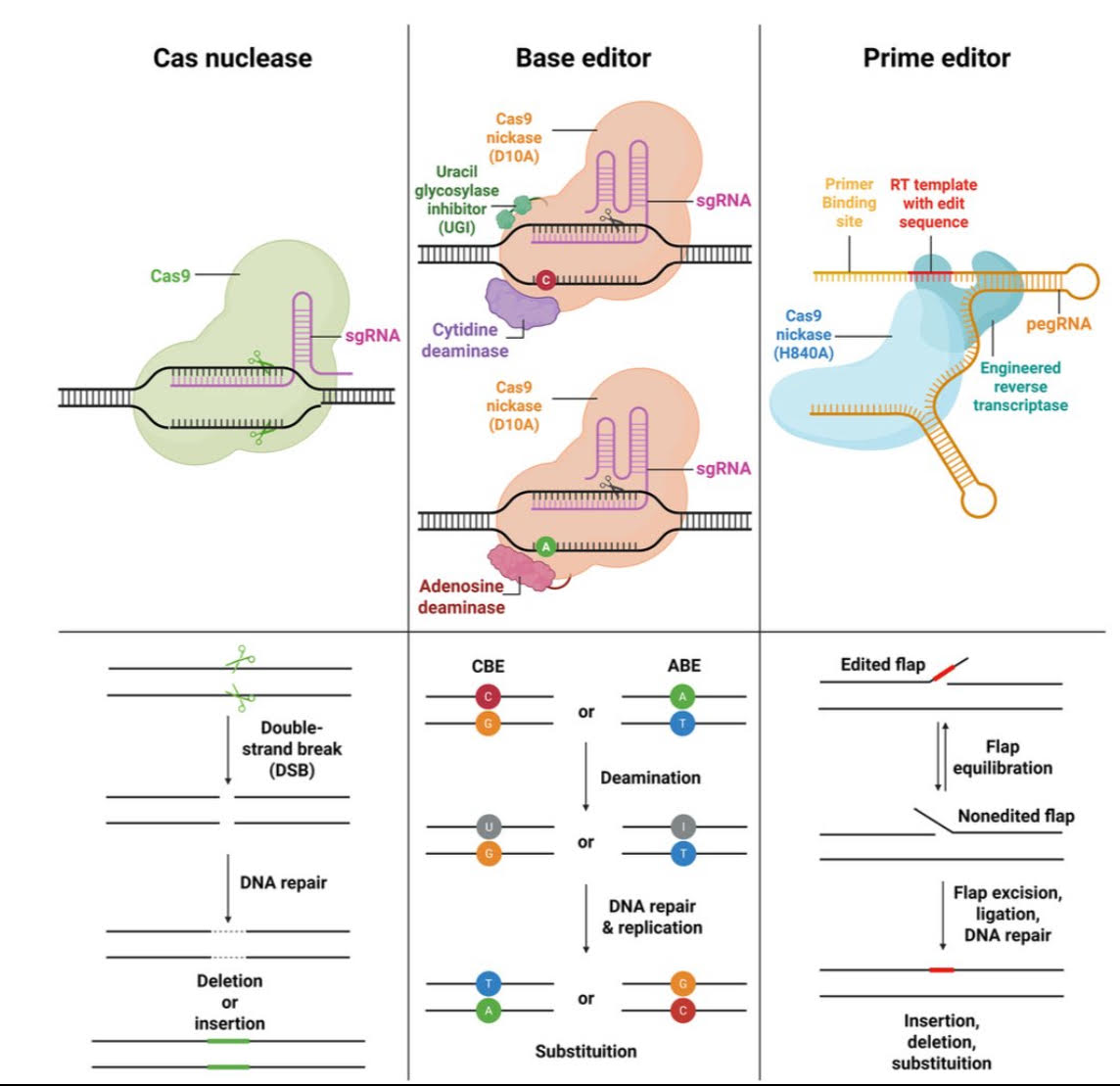
Artificial intelligence (AI) is playing a transformative role in the development and refinement of CRISPR genome editing technologies. By harnessing the power of machine learning and large-scale biological datasets, AI has significantly advanced the design of guide RNAs (gRNAs) for a wide range of CRISPR-based tools, including nucleases, base editors, and prime editors. These improvements have led to increased precision, reduced off-target effects, and more predictable editing outcomes. Specialized AI models such as DeepCRISPR, DeepSpCas9, inDelphi, and SPROUT enable researchers to predict gRNA efficiency and the likelihood and type of mutations resulting from CRISPR-induced double-strand breaks.
Beyond guide design, AI is also accelerating the discovery and optimization of novel CRISPR-associated (Cas) proteins. Tools like AlphaFold3, which predict protein structures with high accuracy, are helping identify new Cas variants with improved specificity and function. Moreover, AI’s capacity to generate novel DNA, RNA, and protein sequences is expanding the landscape of genome engineering, pushing beyond natural biological constraints and opening the door to truly personalized gene therapies.
Despite these advances, the effectiveness of AI-driven models still depends heavily on the quality and diversity of experimental training data. Nevertheless, as data collection improves and computational methods become more sophisticated, AI is expected to further enhance the efficiency, safety, and scalability of CRISPR technologies, driving the next generation of precision medicine and synthetic biology.
More readings:
Kim, Mg., Go, Mj., Kang, SH. et al. Revolutionizing CRISPR technology with artificial intelligence. Exp Mol Med (2025). https://doi.org/10.1038/s12276-025-01462-9