His₆-Tagged PNGase F for Removal of N-linked Glycans
A Reliable Tool for Structural Biology & Protein Engineering
MinneBio has expanded its portfolio of high-purity bioprocessing tools with the launch of MinneBio PNGase F (Peptide-N-Glycosidase F), a highly active recombinant enzyme engineered for efficient, broad-spectrum removal of N-linked glycans. Designed for exceptional specificity, MinneBio PNGase F hydrolyzes the amide bond between the innermost N-acetylglucosamine (GlcNAc) residue and the asparagine residue of glycoproteins, releasing high-mannose, hybrid, and complex N-glycans while converting asparagine to aspartic acid. Validated for high-performance deglycosylation of both native and denatured glycoproteins, the enzyme delivers robust, reproducible results across a wide range of applications. It is an ideal solution for mass spectrometry, SDS-PAGE mobility shift assays, glycoprotein characterization, structural biology, protein engineering, and biopharmaceutical quality control.
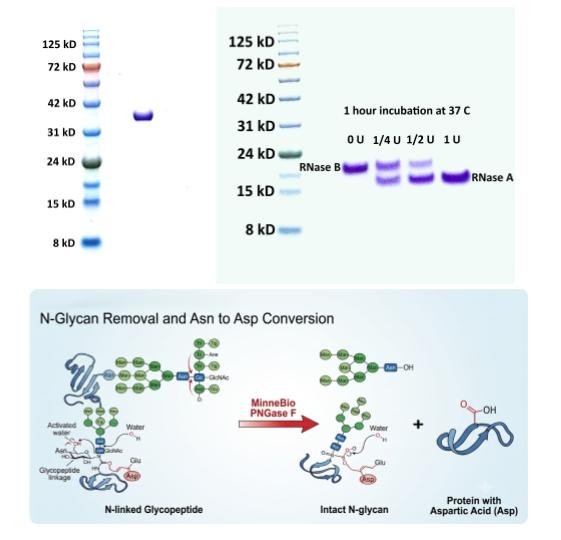
1. Upper Left Image Purified MinneBio His₆-Tagged PNGase F
SDS-PAGE analysis demonstrates the high purity and batch-to-batch consistency of recombinant MinneBio His₆-Tagged PNGase F, ensuring reliable performance for precise and reproducible deglycosylation of glycoproteins in research and bioprocessing applications.
2. Upper Right Image Efficient Deglycosylation of RNase B by MinneBio His₆-Tagged PNGase F
Following incubation with MinneBio His₆-Tagged PNGase F for 1 hour at 37°C, glycosylated RNase B was efficiently converted to the deglycosylated form, exhibiting electrophoretic mobility comparable to RNase A. This result demonstrates the enzyme’s high catalytic activity and specificity for removing high-mannose N-linked glycans while preserving the structural integrity of the target protein.
3. Lower Image: Specific Recognition and Cleavage Mechanism
MinneBio His₆-Tagged PNGase F specifically hydrolyzes the amide bond between the innermost N-acetylglucosamine (GlcNAc) residue of an N-linked glycan and the asparagine residue of glycoproteins. Unlike Endo H, PNGase F efficiently removes high-mannose, hybrid, and most complex N-linked glycans, generating fully deglycosylated proteins suitable for structural analysis, functional characterization, and biopharmaceutical quality assessment.
SHARE
Related Post
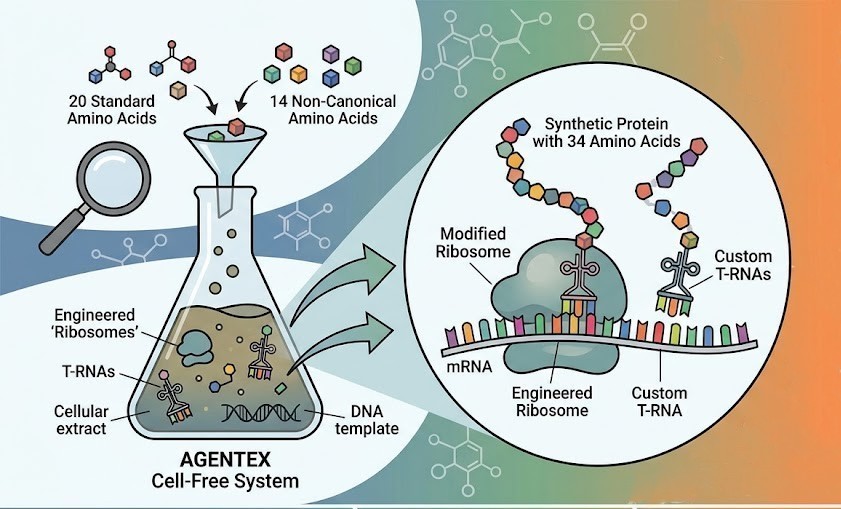
AGENTEX: A New Synthetic Biology Platform Expanding the Possibilities of Protein Engineering
Researchers in Professor George Church’s laboratory at Harvard Medical School, in collaboration...