Every day, billions of cells inside our bodies follow a carefully written set of instructions. These instructions are stored in our DNA — the blueprint that tells each cell when to grow, divide, repair itself, and eventually retire.
But sometimes, the blueprint develops mistakes.
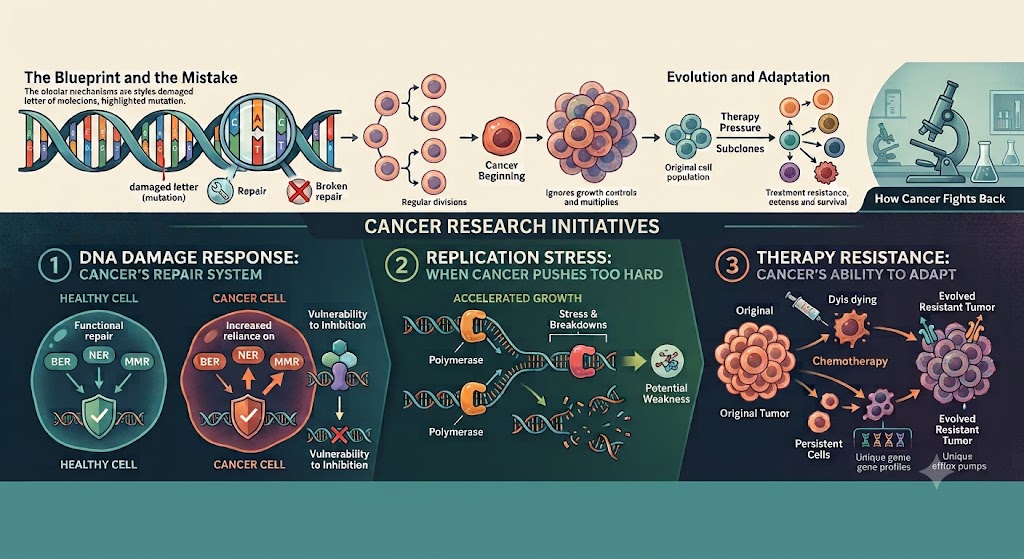
A single damaged letter in DNA may not seem like much. Our cells experience DNA damage every day, and most of the time, powerful repair systems detect and fix these errors. But when those repair systems fail, a cell can begin to change. It may ignore normal signals, divide without control, and refuse to die when it should.
That is the beginning of cancer.
Dr. Tirzah Petta, an Assistant Professor of Clinical Cancer Biology at the Keck School of Medicine, studies this battle every day through her research on gynecologic cancers. Her mission is to understand not only how cancer begins, but why it survives, adapts, and returns even after treatment.
Cancer is not simply a disease of uncontrolled growth. It is an evolutionary process. Cancer cells are constantly changing, finding new ways to survive under pressure. Treatments that work at first may eventually lose their power because some cancer cells discover ways to escape.
This is why the hardest question in cancer research is not only:
“How do we kill cancer?”
It is:
“How does cancer fight back?”
In her laboratory, Dr. Petta focuses on three critical areas.
Every time a cell divides, it must copy billions of DNA instructions. Mistakes can happen. Healthy cells have sophisticated repair systems that protect the genome.
Cancer cells often depend on these repair pathways to survive. By understanding how cancer repairs its damaged DNA, researchers can identify weaknesses and develop treatments that selectively target cancer cells.
Cancer cells grow rapidly. To keep dividing, they must copy their DNA at an accelerated pace. But this creates stress inside the cell.
Imagine a factory running its machines beyond their limits. Eventually, breakdowns occur.
Replication stress creates vulnerabilities that scientists can exploit, turning cancer’s greatest strength — rapid growth — into a potential weakness.
One of the greatest challenges in oncology is treatment resistance.
Some cancer cells survive chemotherapy, radiation, or targeted therapies. These surviving cells can evolve and create new tumors that are harder to treat.
Understanding why resistance develops is essential for designing longer-lasting and more effective therapies.
The future of cancer treatment depends on connecting discoveries made in the laboratory with decisions made in the clinic. By studying cancer at the molecular level, researchers can uncover hidden weaknesses and develop therapies tailored to individual patients.
Behind every experiment is a patient waiting for better answers.
Behind every discovery is hope.
Cancer research is not just about understanding a disease. It is about rewriting the future for millions of people — one discovery, one therapy, and one life at a time.
SHARE