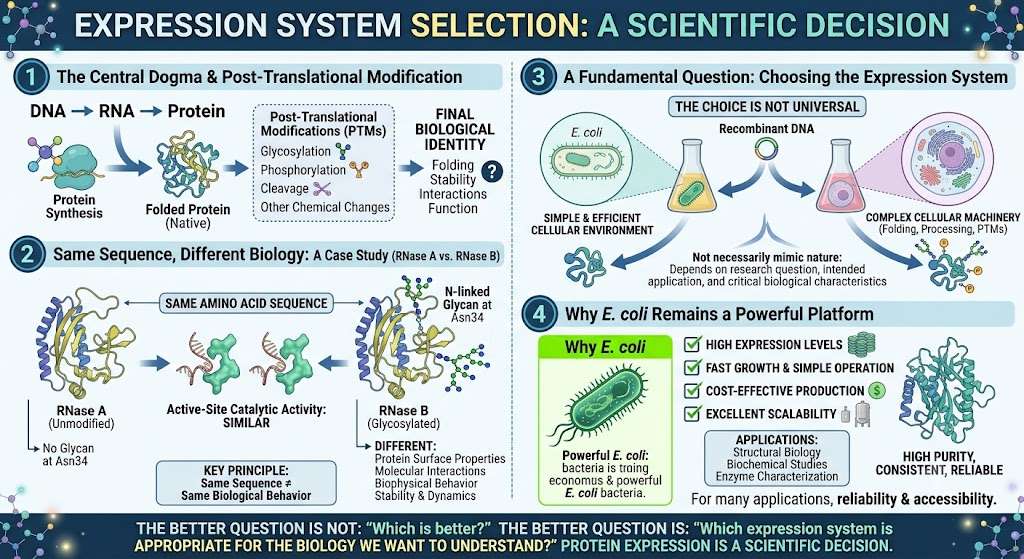
The central dogma of molecular biology teaches us that biological information flows from DNA → RNA → protein. After translation, proteins undergo a variety of post-translational modifications, including glycosylation, phosphorylation, and other chemical changes that shape their final biological identity. These modifications can profoundly influence protein folding, stability, molecular interactions, receptor recognition, and ultimately biological function.
A classic example is RNase A and RNase B. Both proteins have the same amino acid sequence, but RNase B contains an N-linked glycan at Asn34, while RNase A does not. Does this glycosylation dramatically change the enzyme’s catalytic activity? Not necessarily. As enzymes, RNase A and RNase B have very similar catalytic properties. They both efficiently cleave RNA substrates through the same active-site mechanism. However, the added glycan can influence other characteristics, including: Protein surface properties, Molecular interactions, Biophysical behavior, Stability and conformational dynamics. This example highlights an important principle: The same sequence does not always mean the same biological behavior.
These examples raise a deeper question: When producing recombinant proteins, should we always choose the expression system that best mimics nature? The answer is: Not necessarily. Each system has its own strengths and limitations. The best choice depends on what we want to study, the intended application, and the biological characteristics that matter most. No expression system is universally superior to another. The right choice depends on the biological question and the intended applications. The cellular environment in which a protein is produced plays a critical role in shaping its final form. In nature, proteins are created within complex cellular systems equipped with machinery for folding, processing, and post-translational modification.
For many in vitro applications, simplicity is often an advantage. E. coli expression remains one of the most powerful tools in protein science because it offers:
✅ High expression levels
✅ Fast growth and simple operation
✅ Cost-effective production
✅ Excellent scalability for research and industrial applications
Structural biology, biochemical studies, and enzyme characterization often require proteins that are highly pure, consistent, and easy to produce. For many applications, E. coli provides the reliability and accessibility needed to answer fundamental scientific questions. These advantages make E. coli expression one of the most powerful and widely used platforms in protein science.
“Which expression system is better?” The better question is: “Which expression system is appropriate for the biology we want to understand?” Protein expression is not only a manufacturing decision — it is a scientific decision.
SHARE